I attended an event in Boston on September 15th called Housing, Land Use, and Building Reform, sponsored by the Boston Foundation, Boston Indicators, and the Boston Society for Architecture. There were three main speakers.
Permitting Delays
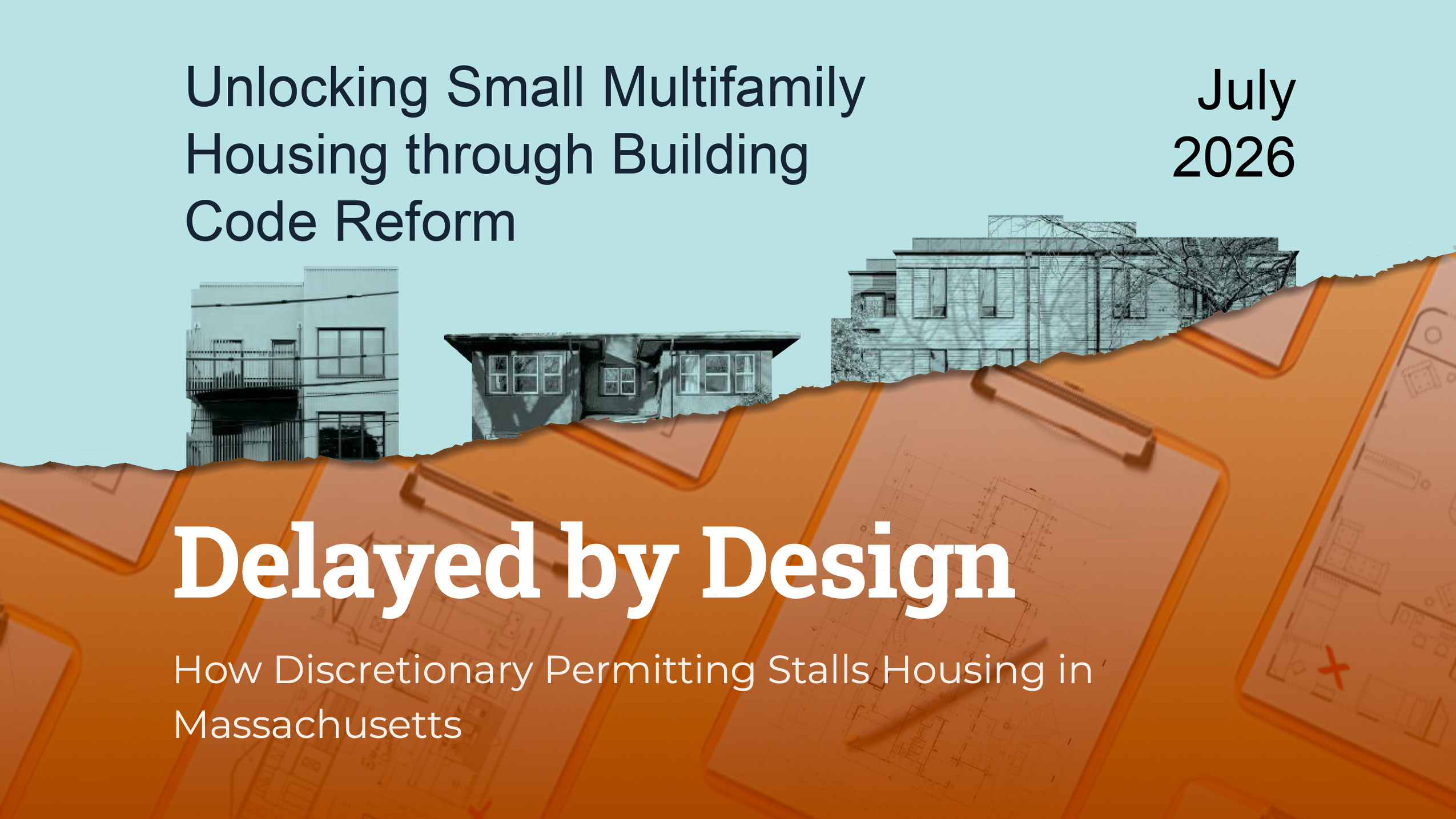
Jonathan Berk from re:Main presented a new report called Delayed by Design: How Discretionary Permitting Stalls Housing in Massachusetts. Some of my notes:
- Unpredictability and friction in permitting processes from one municipality to another are a major challenge for builders of housing.
- “Discretionary” is a spectrum, with “by-right” permitting on one side and “discretionary” permits like special permits and variances on the other. Site plan review is somewhere in the middle.
- Site plan review reform is currently being discussed at the state level.
- If there is an uptick in permit applications, staff capacity to review projects may become a bottleneck. After Lexington’s MBTA-C zoning led to an influx of permit applications, Lexington incorporated third-party engineering review to add capacity and speed up the permitting process.
- One case study, pages 43-46, looks at the review and approval of a early project in Arlington’s MBTA-C zoning district. It’s an interesting read and has some favorable things to say about the ARB and Arlington’s process in general.
Building Code Reform
Sam Naylor from Nominal presented another new report called Unlocking Small Multifamily Housing through Building Code Reform. He also discussed another report from 2024 called Legalizing Mid-Rise Single-Stair Housing in Massachusetts.
- Building code reforms could unlock the potential for multifamily housing development on smaller lots, without the need for parcel aggregation.
- Currently, the building code has a “cliff” between the residential code (which covers 1 and 2-unit buildings) and the commercial code (which covers anything from 3 units and up). This adds cost and often makes small multifamily projects unfeasible.
- The requirement for two separate egress stairs with a corridor between them is extremely limiting for the design. It usually results in standardized, repetitive, boxy buildings with long hotel-style corridors and units with light on only one side.
- Other code requirements that add cost include sprinklers, elevators, and energy code requirements. These are all important, but there are reforms that could reduce cost and complexity without reducing safety, accessibility, or performance.
- Building codes are generally based on national model codes, but reform at the national level is a slow process. Massachusetts has an opportunity to act faster with reforms that would make it easier to build small multifamily housing without compromising safety and other goals.
Zoning Reform
Amy Dain from Boston Indicators presented a talk called “Residential Regulatory Reform from A to Zoning”. The talk covered observations about the history and future of zoning in Massachusetts and drew on previous reports including Equitable Zoning by Design. Some of my notes:
- What are the tools that can be used to reform zoning to allow more housing?
- Persuasion. We have been trying for 50+ years, it is important but by itself persuasion will not be enough.
- Incentives. Ex.: Chapter 40R Smart Growth Zoning. Again, this is important and it has increased housing production, but by nowhere near the amount that is needed.
- Mandates. The MBTA Communities act has been implemented almost everywhere and is showing promising results as far as creating new housing. However, it was a giant, exhausting political lift and there’s limited capacity to do something like that again.
- State pre-emption. Amy argues that bypassing local zoning in some cases may be the most effective way to allow more housing to be built. Example: State ADU law.
- Complexity is a major issue. Each of the 351 municipalities in MA has layers and layers of different rules. Opportunities for regulatory reform include:
- Standardize rules among communities
- Adopt best practices
- Regionalization (i.e., standardize zoning at a county or regional level)
- Improve cross-departmental coordination. For example consolidate permitting processes that are currently separate (planning, building, stormwater, historic…)
Panel
A panel discussion followed, with the three presenters plus two others, Jonathan Lee Cozzens (a developer) and Abby McCabe (Planning Director, Town of Lexington). A couple points:
- Design guidelines have traditionally been used to address the appearance of the building from the outside. One panelist wondered whether they should also address quality of life issues for the building occupants, such as access to daylight.
- Amy Dain pointed out that part of the reason many cities and towns have their own regulations is that state regulations for wetlands protection, stormwater, etc. were insufficient. If state regulations were improved, it would obviate the need for each municipality to set its own rules.
The audience included planning staff, city councilors, and planning board members from towns and cities including Lexington, Newton, Somerville, Lincoln, and Cambridge. I hope that we can encourage Arlington representatives to attend future events like these, both to share what we’re doing and to learn more about these state-level conversations.